The Nasdaq was up double digits for the year on November 4 and now it's negative.
This pattern has quite literally never happened before.
Dating back to 1972, there has not been a single year in which the Nasdaq closed up 10% or more for the year on any day in November before later turning red.
The closest analog is 2018. That year the index was up more than 10% by the middle of October, but then turned negative in mid-December and finished down 3.9%.
The latest AI-fueled sell-off worked much faster following the Nasdaq’s record close on October 6, up nearly 19% year-to-date at that point. It dropped back to a 10.7% gain on November 4, and twelve trading days later it was down 2.7% year-to-date.
Back in 2018 that same round-trip took 41 trading days.

On Friday alone, the Nasdaq fell 5% and finished the week down 10%, its worst stretch since March 2020.
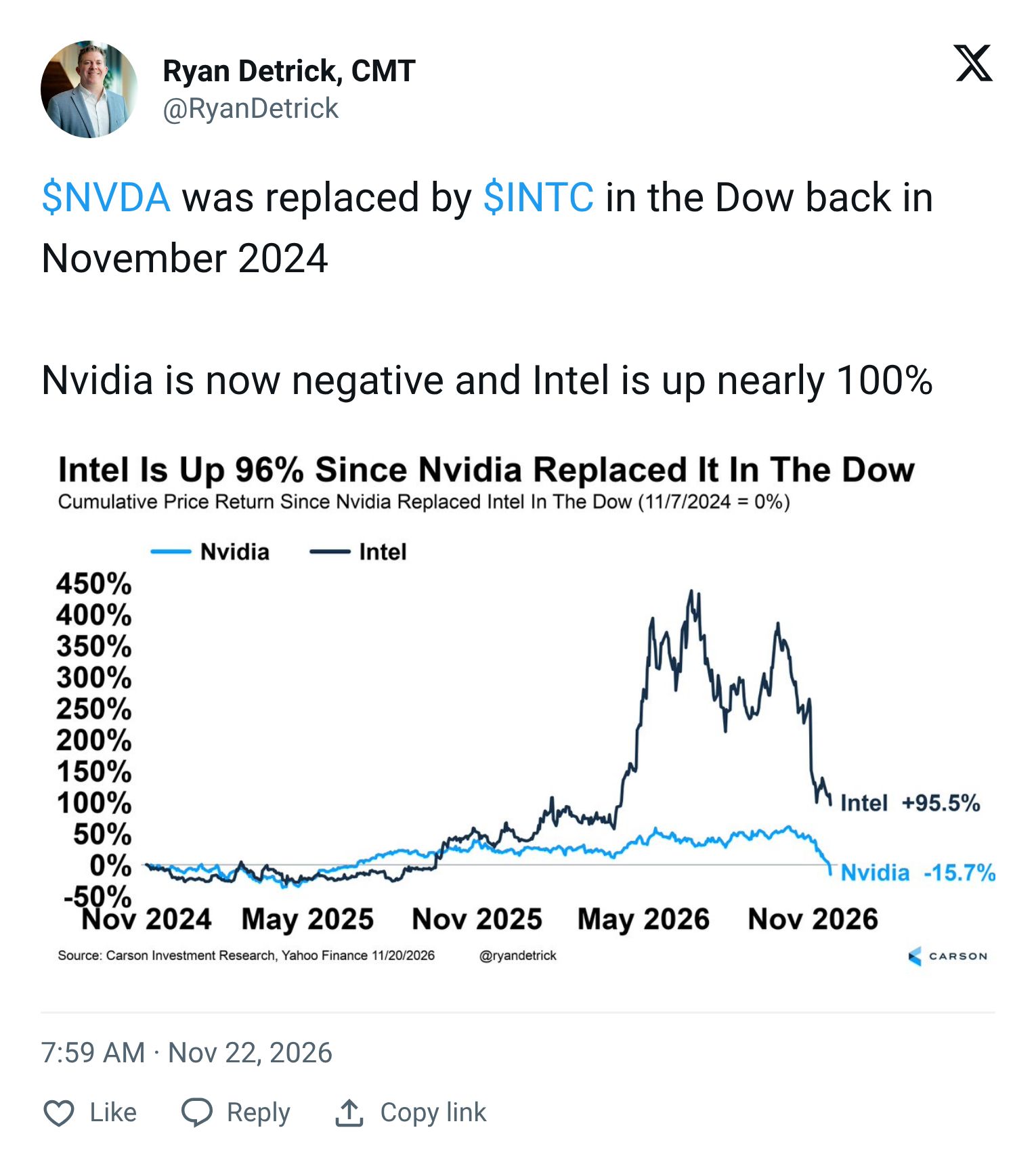
Nvidia sank 14% following a Reuters report that the SEC is looking into its accounting practices. Anthropic’s historic IPO, too, did nothing to juice the broader AI trade, as I discussed on Fox Business that morning.
Among other negative catalysts:
Democrats’ midterm win raised fears of a slowing data center buildout
A new short sell report published on AMD
Ongoing Jensen Huang drama
To reiterate the severity of the selling pressure in another way, the Nasdaq ended October up 9.4% on the year, and with the index now negative, that 9.4% ended up being the largest October-end gain ever erased by November or December in the last four decades.
The previous record was 5.8% in 2018.

In today’s market, no lead is big enough and no momentum impervious to sudden reversals.
That said, I’m not someone who believes Anthropic’s debut marked the top AI trade, as other commentators have floated.
If we put aside the trillions in expected AI capex, historic earnings strength, and Wall Street’s still-lofty expectations for 2027, I find some comfort knowing that the last time the Nasdaq erased a lead like this, it rose 35% the following year.

Elsewhere
🎯 Trump threatened a “tremendous tax” on US companies that build data centers abroad. He said Friday that US companies will be banned from building data centers in other countries, though Alphabet, Amazon, Microsoft, Meta and Oracle already operate them overseas. (CNBC)
📊 Black Friday puts the consumer in focus for an AI-rattled market. The National Retail Federation expects 182.7 million people to shop over the five-day Thanksgiving stretch, slightly below last year’s 186.9 million. (Reuters)
🤖 CrowdStrike is reportedly in talks to buy Zscaler (CNBC). Zscaler shares jumped about 16% in extended trading Friday after Bloomberg reported the talks, while CrowdStrike fell about 5%.
Rapid-fire
Oracle says its OpenAI infrastructure contract is now fully funded (Reuters)
Bitcoin is on pace for its worst month since June 2022 (Yahoo Finance)
Databricks is in early talks to raise money at a $225 billion valuation (Reuters)
Dell and Deere headline 8 key earnings reports before Thanksgiving (Opening Bell Daily)
There’s no obvious bullish catalyst right now for the AI trade (Searching for Signals)
Wall Street banks will split about $550 million in fees from Anthropic’s IPO (Reuters)
Anthropic’s record IPO failed to deliver the bullish catalyst for the AI trade (Opening Bell Daily)
This biotech stock could boom as it lines up cancer drugs to outrun a patent cliff (Best Ideas Club)
On this day
🗓 November 23, 2008: The Treasury, the Federal Reserve and the FDIC agreed to rescue Citigroup with a $20 billion investment and protection against unusually large losses on about $306 billion of real estate-backed assets.
Last thing
💡If you find this newsletter valuable, you can help shape its future by taking our 2-minute reader survey. Your feedback directly influences our content.

