Wall Street’s fear gauge just posted a bigger one-day percentage jump than anything it managed in March 2020.
The VIX surged 70% Thursday to 28.18 for its biggest one-day change since December 2024, and bigger than any single session in March 2020.
The selling pressure across tech stocks was just as brutal. The Nasdaq-100 erased $2.3 trillion in market value, and the Nasdaq Composite sank 5.52% for its worst drop since last April’s tariff tantrum.
Consider that not even in March 2020, when the pandemic shut down the global economy, did the VIX rise this much in percentage terms.
Its biggest day back then was a 42.9% jump.

Now, this does not mean we are sitting in a “worse” market than 2020.
Back in March 2020, the VIX was already elevated above 30, so even huge point moves showed up as smaller percentage gains. Earlier this week on Wednesday it closed at just 16.61.
But the flip illustrates how investors went from calm to scrambling in one session.
Indeed, the S&P 500 fell 4.35% and the Nasdaq Composite dropped 5.52% to completely reverse Wednesday’s post-midterm rally.
The VIX traded as high as 28.36 and closed near that level, though its 50-day average still sits at a relatively muted 16.7.

Generally speaking, a fear spike from a low base can say as much about positioning as about the economy.
When volatility is “cheap,” many investors carry less protection. A sudden jolt can send them rushing to buy it at once.
Meanwhile, a low starting point also makes the percentage move look bigger.
From a close of 16.61 to 28.18, the gauge jumped by more than two-thirds in a single session and cleared its 50-day average by more than 10 points.
To be sure, after each of the five biggest one-day percentage jumps in VIX history before Thursday, the S&P 500 was higher a month later.
Volatility tends to cluster, so it’d be wise to brace for more chop over the coming days.
But it’d be just as logical to expect higher asset prices in the months ahead.

Elsewhere
📉 The Nasdaq Composite sank into a correction. The index fell about 5.5% Thursday and was more than 11% below its October record as chip stocks led the selloff. (CNBC)
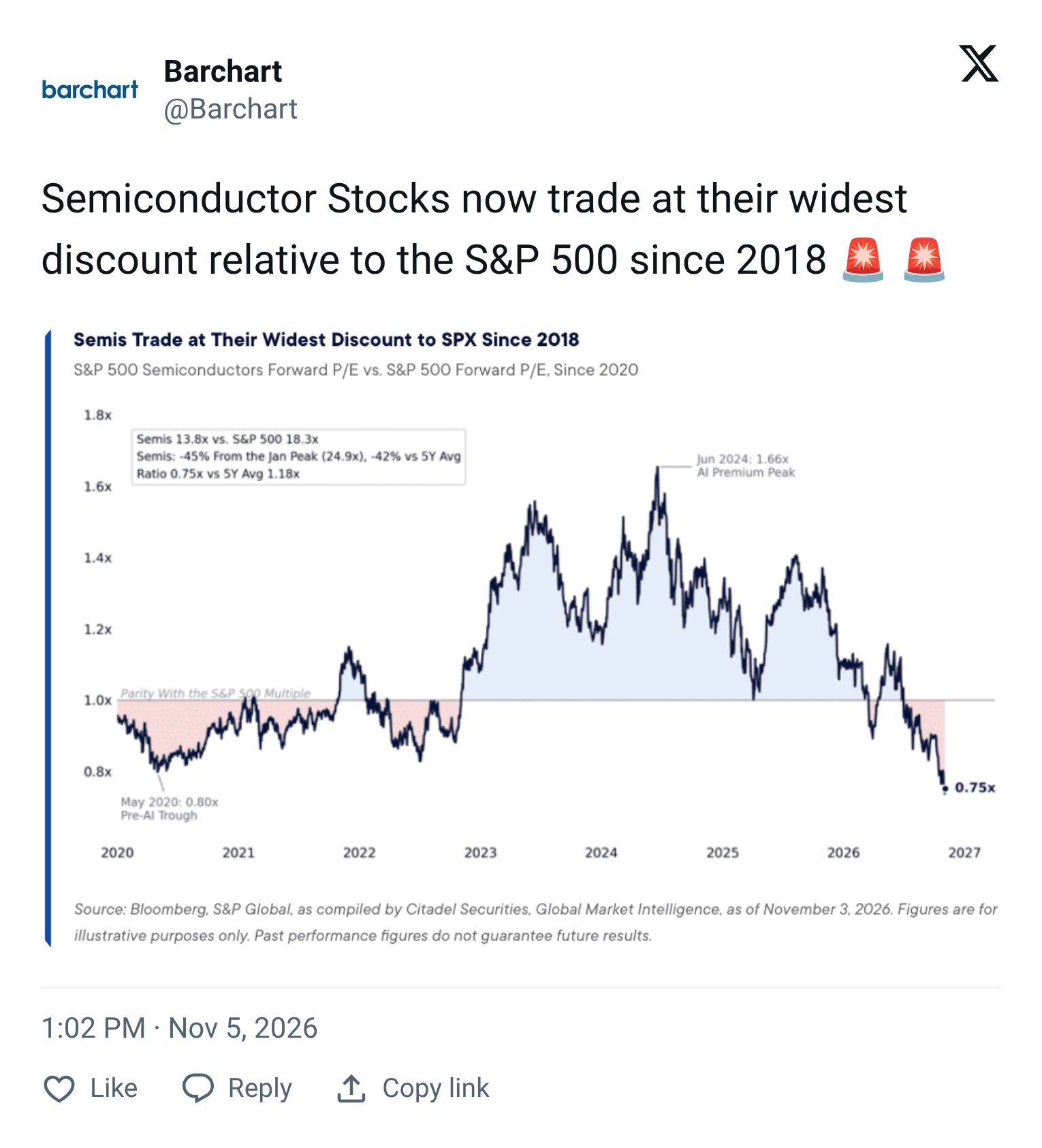
📊 The PHLX Semiconductor Index fell 12%. That cut the index’s year-to-date gain to about 27% as Sandisk sank 22% and Arm dropped 13%. (Yahoo Finance)
🤖 Qualcomm’s disappointing profit forecast dragged chip stocks with it. Qualcomm and Nvidia each dropped more than 9%, and AMD, Micron and Applied Materials all posted double-digit losses. (CNBC)
Full Signal
Drew Pettit is the chief investment strategist at Roundhill Investments and a former Citi veteran. We sat down to discuss why the AI trade looks late-cycle, how much growth is already priced in, and the case for photonics stocks in 2027.
Tune in on Spotify, Apple Podcasts, or YouTube.
Rapid-fire
Bitcoin sold off further as it traced tech stocks (WSJ)
Retail traders are throwing in the towel on the “buy the dip” trade (Yahoo Finance)
TripAdvisor plunges 27% after a leadership shakeup and weak guidance (CNBC)
Anthropic’s IPO odds tumbled on prediction markets Thursday (Yahoo Finance)
Tesla and SpaceX sink as AI buildout bets reverse (CNBC)
Big Tech capex tops $200 billion in a quarter (Opening Bell Daily)
On this day
🗓 November 6, 1907: Newspapers reported that the first ship carrying European gold had docked in New York, with more on the way, as imports helped ease the Panic of 1907. The crisis spurred the reform movement that created the Federal Reserve in 1913.
Last thing
💡If you find this newsletter valuable, you can help shape its future by taking our 2-minute reader survey. Your feedback directly influences our content.

