American voters rejected AI data centers at the ballot boxes yet the biggest owners of them rallied after midterm results came in.
That suggests, in the market’s view, any political pushback on new data centers make the ones that are already built — and the companies that own them — more valuable, not less.
Democrats flipped both the House and Senate in the midterms, and voters also sided against data centers in nearly every one of 41 local ballot measures across nearly a dozen states.
While counterintuitive, Wall Street read that as a win for the incumbents.
Microsoft jumped nearly 7% to a record high and Apple surged 5.3% to revisit a $5 trillion market cap.
Amazon and Alphabet added 6.1% and 3.1%, respectively.

This resembles the classic expectation for a “regulatory wall,” which assumes new entrants will get hurt more than the incumbents, which in this case are the existing hyperscalers and the biggest infrastructure spenders.
Meanwhile, the rest of the AI trade across chips and power saw far less upside.
Nvidia -3.1%
Constellation Energy -6.7%
CoreWeave -9.8%
Vistra -13.8%
Indeed, Goldman Sachs analysts estimated that Democratic wins at the state level could put about 45% of planned US data-center capacity at risk of moratoriums.
That’s a real revenue problem for chipmakers, neoclouds and the utilities lined up to power them.
For the hyperscalers, though, a slower buildout could ultimately alleviate the pressure to keep borrowing and spending, and investors cheered that relief.

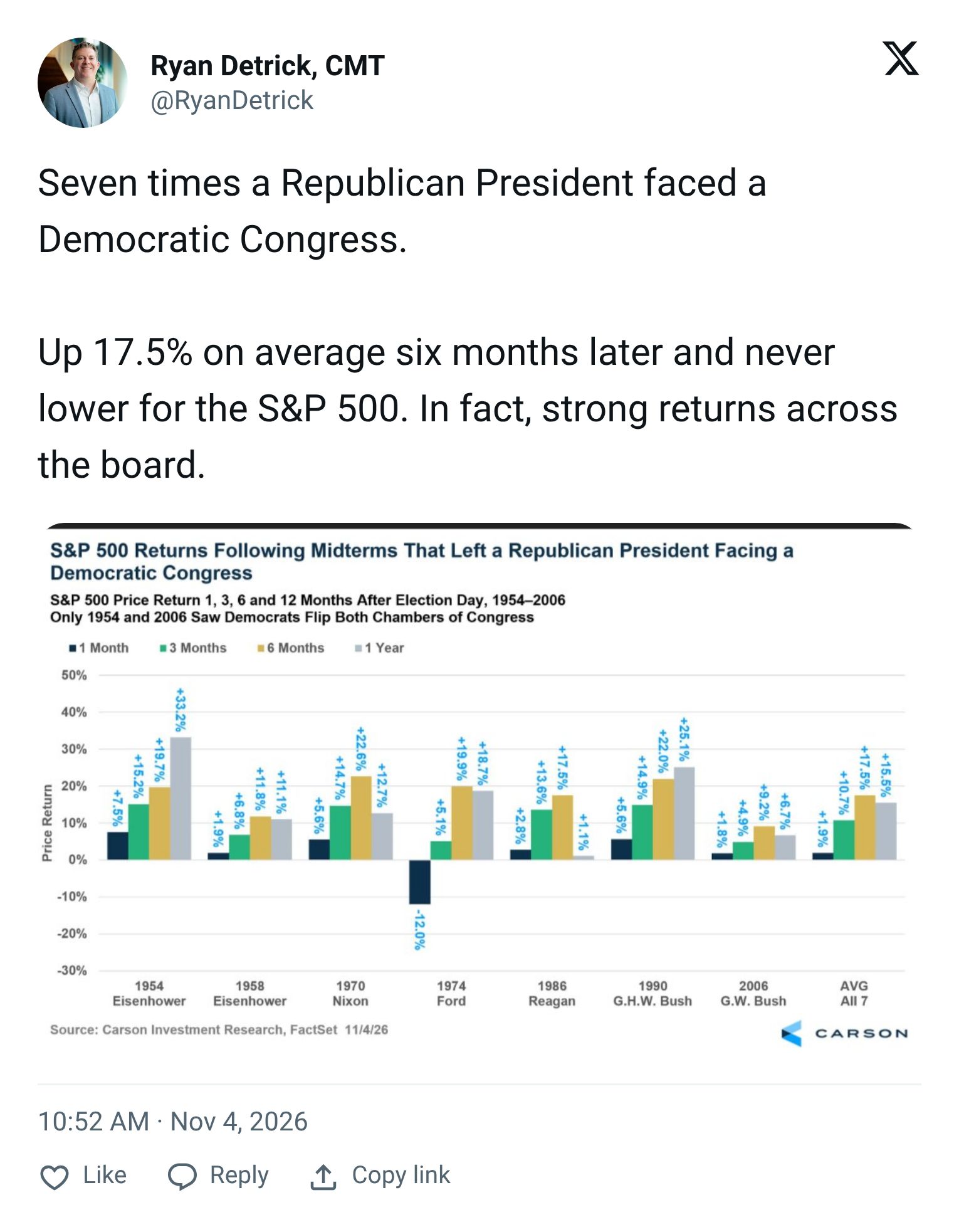
None of this touches the bullish midterm seasonality that I’ve been writing about for the last several weeks.
Market tend to like political gridlock, and the fourth quarter of a midterm year averages almost double the return of all other fourth quarters.
Plus, dating back to 1950, the S&P 500 has averaged a roughly 17% return in the post-midterm election year.
The index has also climbed in a post-midterm year in 19 of 19 instances over the last seven decades.

So my sense is that the AI trade is not over just because Democrats took power.
But a regime change like this one does open the door to the existing AI winners extending their lead against anyone trying to catch up.
Elsewhere
📈 3M shares jumped nearly 10% to an 8-year high. The industrial company agreed to pay $7.35 billion to settle personal injury claims tied to its “forever chemicals,” with payouts spread over nine years. (Reuters)
🚀 Novo Nordisk raised its outlook after Wegovy pill sales blew past estimates. The drugmaker now sees adjusted revenue and operating profit growth between negative 2% and 2% at constant exchange rates, up from negative 6% to flat. (CNBC)
📊 Citadel Securities’ Scott Rubner says stocks are set up for year-end gains. He pointed to resilient corporate earnings and lackluster investor positioning after the Nasdaq 100 fell 10% from its early-October peak. (Bloomberg)
Full Signal
Rhys Williams is the chief investment officer at Wayve Capital Management. We sat down to discuss why today’s AI boom isn’t a replay of 1999, the barbell strategy he likes for 2027, and his favorite stocks right now in health care, energy and AI.
Tune in on Spotify, Apple Podcasts, or YouTube.
Rapid-fire
CVS plans to split into two public companies by the first half of 2028 (CNBC)
Sandisk shares sank nearly 8% as data center worries hit memory stocks (Yahoo Finance)
Euro zone inflation jumped to 4% in October for a three-year high (CNBC)
AMD data center sales hit a record $8.5 billion last quarter (Opening Bell Daily)
Trimble cut its growth outlook as European freight markets slowed (Yahoo Finance)
China is coordinating a push for its companies to expand overseas mining stakes (CNBC)
Apple is beating Big Tech without Big Tech’s spending (Opening Bell Daily)
On this day
🗓 November 5, 2007: PetroChina’s Shanghai debut briefly made it the first company ever valued at more than $1 trillion. Its shares more than doubled from the offer price on the first day of trading.
Last thing
💡If you find this newsletter valuable, you can help shape its future by taking our 2-minute reader survey. Your feedback directly influences our content.

